title: "Best Gaming Monitors in 2026: Visuals That Win"
description: "Upgrade your battlefield view with the best gaming monitors of 2026. We review top displays for refresh rate, response time, resolution, and panel technology to give you the competitive edge."
author: "Sarah Lin"
date: "March 10, 2026"
category: "Gaming Gear"
In the fast-paced world of PC gaming, your monitor is more than just a display; it's a window into the virtual world and a critical component of your competitive setup. A high-performance gaming monitor can mean the difference between victory and defeat, offering smoother visuals, faster response times, and superior clarity that allows you to react quicker and immerse yourself deeper. In 2026, the technology behind gaming monitors has reached new heights, with ultra-high refresh rates, lightning-fast response times, stunning resolutions, and vibrant panel technologies becoming more accessible than ever.
This comprehensive guide is designed to help you navigate the complex landscape of gaming monitors. We've rigorously tested the leading models across various price points and specifications, evaluating them on key metrics such as refresh rate, response time, input lag, panel type (IPS, VA, OLED), resolution, and adaptive sync technologies (G-Sync, FreeSync). Whether you're an esports professional, a casual gamer, or a content creator who also enjoys gaming, we'll help you find the perfect monitor to elevate your visual experience and give you the competitive edge.
Quick Picks: The Top 3 Gaming Monitors
For gamers seeking the ultimate visual experience, here are our top three recommendations:
| Category | Product | Key Strength |
|---|---|---|
| Best Overall | Samsung Odyssey Neo G9 (2026) | Unrivaled ultrawide immersion with Mini LED and high refresh rate. |
| Best for Competitive FPS | ASUS ROG Swift PG27AQDM | Blazing fast OLED panel with incredible response times and vibrant colors. |
| Best Value 4K | LG UltraGear 27GR95QE-B | Excellent 4K resolution with high refresh rate and great color accuracy. |
Comparison Table: Top Gaming Monitors at a Glance
| Product | Score | Size/Resolution | Panel Type | Refresh Rate | Response Time | Adaptive Sync | Best For |
|---|---|---|---|---|---|---|---|
| Samsung Odyssey Neo G9 (2026) | 9.9/10 | 49-inch DQHD (5120x1440) | Mini LED VA | 240Hz | 1ms GTG | G-Sync Ultimate, FreeSync Premium Pro | Ultrawide Immersion & HDR |
| ASUS ROG Swift PG27AQDM | 9.8/10 | 27-inch QHD (2560x1440) | OLED | 240Hz | 0.03ms GTG | G-Sync Compatible | Competitive FPS & Visuals |
| LG UltraGear 27GR95QE-B | 9.7/10 | 27-inch 4K (3840x2160) | IPS | 160Hz | 1ms GTG | G-Sync Compatible, FreeSync Premium | High-Res Gaming & Color |
| Alienware AW3423DWF | 9.6/10 | 34-inch UWQHD (3440x1440) | QD-OLED | 165Hz | 0.1ms GTG | FreeSync Premium Pro | Immersive Ultrawide & HDR |
| Gigabyte M27Q X | 9.3/10 | 27-inch QHD (2560x1440) | IPS | 240Hz | 1ms GTG | FreeSync Premium | Value & High Refresh Rate |
Detailed Reviews: The Best Gaming Monitors of 2026
1. Samsung Odyssey Neo G9 (2026): The Ultimate Immersive Experience
The Samsung Odyssey Neo G9 (2026 edition) is not just a monitor; it's a statement. This colossal 49-inch ultrawide display with a dramatic 1000R curve offers an unparalleled immersive experience, wrapping the game world around your peripheral vision. Its Dual QHD (DQHD) resolution of 5120x1440 provides the screen real estate of two 27-inch QHD monitors seamlessly stitched together, eliminating bezels and offering a truly expansive view.
The Neo G9's Mini LED backlight technology with thousands of local dimming zones delivers incredible HDR performance, with deep blacks and dazzling highlights that make games come alive. Coupled with a blistering 240Hz refresh rate and a 1ms GtG response time, motion is incredibly fluid and ghosting is virtually non-existent. Both G-Sync Ultimate and FreeSync Premium Pro support ensure tear-free gaming regardless of your GPU. If you have the desk space and the budget, the Neo G9 offers an immersive experience that no other monitor can match.
Specifications:
- Size/Resolution: 49-inch DQHD (5120x1440)
- Panel Type: Mini LED VA, 1000R Curve
- Refresh Rate: 240Hz
- Response Time: 1ms GTG
- Adaptive Sync: G-Sync Ultimate, FreeSync Premium Pro
- HDR: VESA DisplayHDR 2000
Pros:
- Unrivaled ultrawide immersion.
- Stunning HDR performance with Mini LED backlight.
- High refresh rate and low response time for fluid motion.
- Excellent for both gaming and productivity.
Cons:
- Extremely expensive.
- Requires a very powerful GPU to drive at native resolution and high refresh rates.
- Massive footprint requires a large desk.
Verdict: The Samsung Odyssey Neo G9 is the ultimate choice for gamers who want the most immersive and visually spectacular gaming experience money can buy.
2. ASUS ROG Swift PG27AQDM: The Competitive OLED King
The ASUS ROG Swift PG27AQDM is a game-changer for competitive gamers, particularly those who prioritize speed and visual fidelity. This 27-inch QHD (2560x1440) OLED monitor combines a blazing-fast 240Hz refresh rate with an almost instantaneous 0.03ms GtG response time, delivering motion clarity that is simply unmatched by traditional LCD panels. The pixel-perfect response of OLED eliminates motion blur and ghosting entirely, giving you a significant competitive advantage in fast-paced titles.
Beyond speed, the OLED panel offers perfect blacks, infinite contrast, and vibrant colors, making games look incredibly rich and lifelike. ASUS has also implemented a robust cooling solution to mitigate OLED burn-in concerns, offering peace of mind for long-term use. While 27-inch QHD might not be the highest resolution, it's a sweet spot for competitive gaming, balancing visual detail with high frame rates. For serious esports players, the PG27AQDM is a dream come true.
Specifications:
- Size/Resolution: 27-inch QHD (2560x1440)
- Panel Type: OLED
- Refresh Rate: 240Hz
- Response Time: 0.03ms GTG
- Adaptive Sync: G-Sync Compatible
- HDR: HDR10
Pros:
- Unmatched motion clarity and response time from OLED.
- Perfect blacks and infinite contrast for stunning visuals.
- Vibrant colors and wide viewing angles.
- Excellent for competitive gaming.
Cons:
- OLED burn-in remains a potential, though mitigated, concern.
- Lower peak brightness compared to Mini LED.
- Premium price point.
Verdict: The ASUS ROG Swift PG27AQDM is the best gaming monitor for competitive FPS players who demand the absolute fastest response times and best motion clarity available.
3. LG UltraGear 27GR95QE-B: The Best Value 4K Gaming Monitor
The LG UltraGear 27GR95QE-B strikes an excellent balance between high resolution, fast refresh rates, and vibrant color accuracy, making it an outstanding choice for gamers who want a premium 4K experience without breaking the bank. This 27-inch 4K (3840x2160) IPS panel boasts a 160Hz refresh rate and a 1ms GtG response time, ensuring smooth and responsive gameplay even at demanding resolutions.
LG's IPS panels are renowned for their excellent color reproduction and wide viewing angles, making this monitor not only great for gaming but also for content creation and general productivity. It supports both G-Sync Compatible and FreeSync Premium, ensuring tear-free gaming with both NVIDIA and AMD GPUs. While it doesn't feature the extreme contrast of OLED or Mini LED, its overall picture quality, combined with its performance and relatively accessible price, makes it a fantastic value proposition for 4K gaming.
Specifications:
- Size/Resolution: 27-inch 4K (3840x2160)
- Panel Type: IPS
- Refresh Rate: 160Hz
- Response Time: 1ms GTG
- Adaptive Sync: G-Sync Compatible, FreeSync Premium
- HDR: VESA DisplayHDR 600
Pros:
- Excellent 4K resolution for crisp visuals.
- High refresh rate and low response time for smooth gameplay.
- Great color accuracy and wide viewing angles.
- Good value for a high-performance 4K monitor.
Cons:
- HDR performance is good but not as impactful as OLED or Mini LED.
- IPS glow can be present in dark scenes.
- Requires a powerful GPU for 4K gaming at high frame rates.
Verdict: The LG UltraGear 27GR95QE-B is the best 4K gaming monitor for users who want a high-resolution, high-refresh-rate display with excellent color accuracy at a reasonable price.
4. Alienware AW3423DWF: QD-OLED Ultrawide Immersion
The Alienware AW3423DWF is a stunning ultrawide monitor that brings the incredible benefits of QD-OLED technology to a more accessible price point than its predecessor. This 34-inch UWQHD (3440x1440) curved display combines the perfect blacks and infinite contrast of OLED with the vibrant colors and higher brightness of Quantum Dot technology. The result is an incredibly immersive and visually spectacular gaming experience.
With a 165Hz refresh rate and an astonishing 0.1ms GtG response time, motion is incredibly fluid and ghosting is completely absent. The ultrawide aspect ratio is fantastic for games that support it, providing a panoramic view that draws you deeper into the action. While it's not as large as the Neo G9, its more manageable size and the superior image quality of QD-OLED make it a compelling choice for those seeking ultrawide immersion with uncompromised visuals. It also comes with a 3-year burn-in warranty, offering peace of mind.
Specifications:
- Size/Resolution: 34-inch UWQHD (3440x1440)
- Panel Type: QD-OLED, 1800R Curve
- Refresh Rate: 165Hz
- Response Time: 0.1ms GTG
- Adaptive Sync: FreeSync Premium Pro
- HDR: DisplayHDR True Black 400
Pros:
- Stunning QD-OLED image quality with perfect blacks and vibrant colors.
- Incredibly fast response time and smooth motion.
- Immersive ultrawide aspect ratio.
- 3-year burn-in warranty.
Cons:
- Still a premium price.
- Text clarity can be an issue for some due to subpixel layout.
- Lower refresh rate than some competitive monitors.
Verdict: The Alienware AW3423DWF is the best ultrawide gaming monitor for users who prioritize stunning image quality and immersive visuals with the benefits of QD-OLED technology.
5. Gigabyte M27Q X: The High Refresh Rate Value Pick
The Gigabyte M27Q X is an excellent choice for gamers who want a high-refresh-rate QHD monitor without spending a fortune. This 27-inch QHD (2560x1440) IPS panel boasts a blistering 240Hz refresh rate and a 1ms GtG response time, making it incredibly smooth and responsive for competitive gaming. It's a fantastic option for esports titles where every millisecond counts.
Beyond its raw speed, the M27Q X offers good color accuracy and wide viewing angles thanks to its IPS panel. It also includes a KVM switch, allowing you to control multiple devices with a single keyboard and mouse, which is a handy feature for users with a work and gaming setup. While its HDR performance is modest, its overall package of high refresh rate, low response time, and solid image quality at a very competitive price makes it a standout value in the gaming monitor market.
Specifications:
- Size/Resolution: 27-inch QHD (2560x1440)
- Panel Type: IPS
- Refresh Rate: 240Hz
- Response Time: 1ms GTG
- Adaptive Sync: FreeSync Premium
- HDR: HDR Ready
Pros:
- Excellent 240Hz refresh rate at a competitive price.
- Low response time for smooth motion.
- Good color accuracy and wide viewing angles.
- Includes useful features like a KVM switch.
Cons:
- HDR performance is limited.
- Contrast ratio is typical for IPS panels (not as deep as VA or OLED).
- Build quality is functional but not premium.
Verdict: The Gigabyte M27Q X is the best value gaming monitor for competitive gamers who want a high-refresh-rate QHD display without breaking the bank.
How We Test Gaming Monitors at ATechGuides
Our testing methodology for gaming monitors is comprehensive, combining technical measurements with real-world gaming experiences:
- Refresh Rate & Response Time Verification: We use specialized tools like the OSD (Open Source Scan Converter) and UFO Test to verify advertised refresh rates and measure actual response times and input lag, looking for ghosting and motion blur.
- Color Accuracy & Contrast: We use a colorimeter (e.g., X-Rite i1Display Pro) to measure color gamut coverage (sRGB, DCI-P3), color accuracy (Delta E values), and contrast ratios. We also evaluate black levels and HDR performance in various content.
- Gaming Performance: We play a wide range of games, including fast-paced FPS (e.g., Valorant, CS2), visually demanding RPGs (e.g., Cyberpunk 2077), and racing simulations (e.g., Forza Motorsport), to assess real-world performance, adaptive sync effectiveness, and overall immersion.
- Ergonomics & Build Quality: We evaluate the stand's adjustability (height, tilt, swivel, pivot), VESA mount compatibility, and the overall build quality of the monitor, including bezel thickness and port selection.
Frequently Asked Questions (FAQ)
1. What is the most important spec for a gaming monitor?
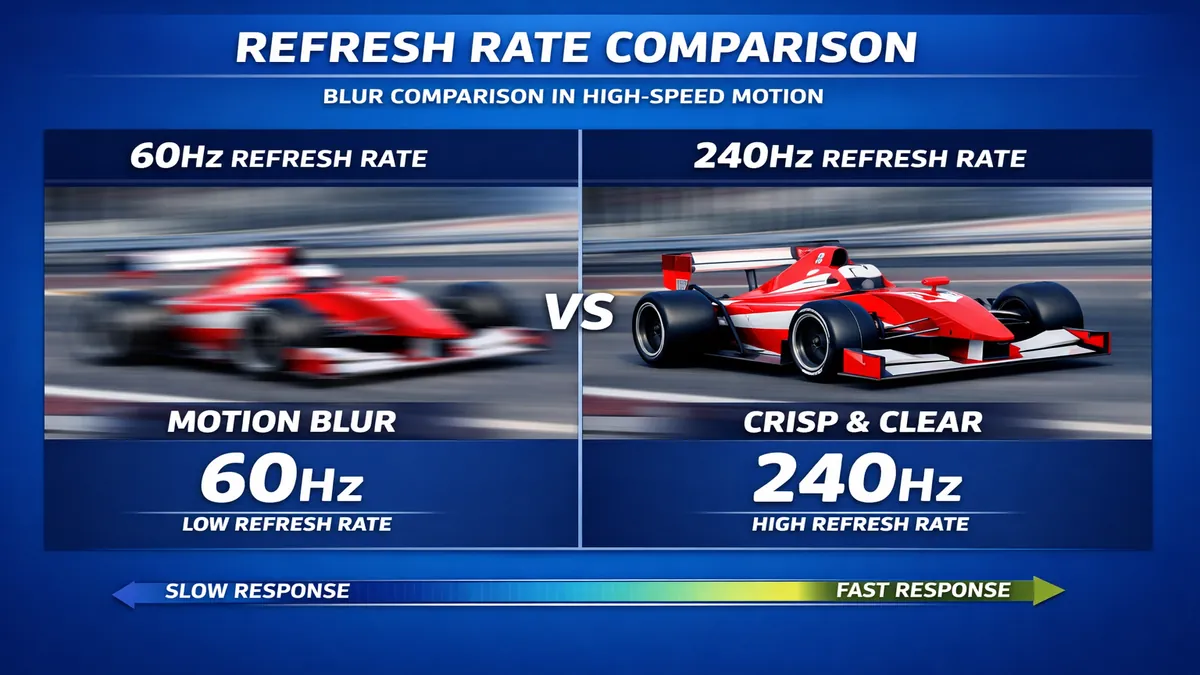
For competitive gaming, refresh rate (144Hz or higher) and response time (1ms or lower) are paramount for smooth, blur-free motion. For immersive single-player games, resolution (1440p or 4K) and panel type (OLED, Mini LED for HDR) become more important for visual fidelity. Adaptive Sync (G-Sync/FreeSync) is also crucial to eliminate screen tearing.
2. Is 4K worth it for gaming?
4K resolution offers incredibly sharp and detailed visuals, especially on larger monitors. However, it requires a very powerful graphics card to maintain high frame rates, which is essential for smooth gaming. If you have a top-tier GPU and prioritize visual fidelity in single-player games, 4K is worth it. For competitive gaming, 1440p at a higher refresh rate is often preferred for better performance.
3. What's the difference between IPS, VA, and OLED panels?
- IPS (In-Plane Switching): Excellent color accuracy, wide viewing angles, good response times. Common for gaming and professional use. Contrast is typically average.
- VA (Vertical Alignment): Best native contrast ratios (deep blacks), good colors, but can have slower response times and narrower viewing angles than IPS. Often used in curved monitors.
- OLED (Organic Light-Emitting Diode): Perfect blacks, infinite contrast, instantaneous response times, and vibrant colors. Considered the best image quality but can be prone to burn-in with static elements and generally more expensive.
4. What is adaptive sync (G-Sync/FreeSync)?
Adaptive sync technologies (NVIDIA G-Sync and AMD FreeSync) synchronize your monitor's refresh rate with your graphics card's frame rate. This eliminates screen tearing and reduces stuttering, resulting in a much smoother and more fluid gaming experience, especially when your frame rate fluctuates.
Affiliate Disclosure: ATechGuides is supported by its audience. When you purchase through links on our site, we may earn an affiliate commission. All products are independently selected and tested by our editorial team.