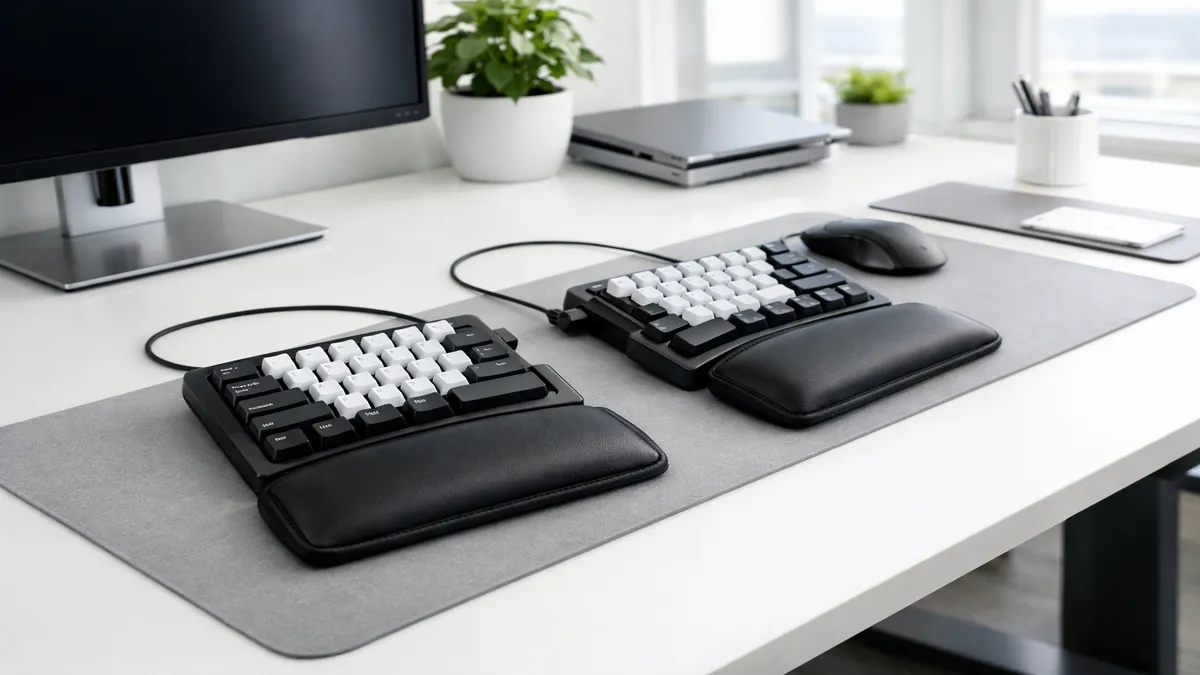
In an era where digital work dominates, the keyboard has become an extension of our bodies. Yet, traditional keyboard designs often force our hands and wrists into unnatural positions, leading to discomfort, pain, and even debilitating conditions like Carpal Tunnel Syndrome or Repetitive Strain Injury (RSI). The solution lies in ergonomic keyboards, devices meticulously designed to promote natural posture, reduce strain, and enhance typing comfort over long periods.
In 2026, ergonomic keyboards have evolved beyond bulky, split designs to offer a diverse range of solutions, from subtly curved layouts to fully customizable split and columnar arrangements. This guide dives deep into the best ergonomic keyboards available today, rigorously tested for their ability to improve posture, reduce fatigue, and maintain high levels of productivity. We've evaluated each model on its design philosophy, adjustability, switch quality, and overall impact on user well-being.
The Imperative of Ergonomics in 2026
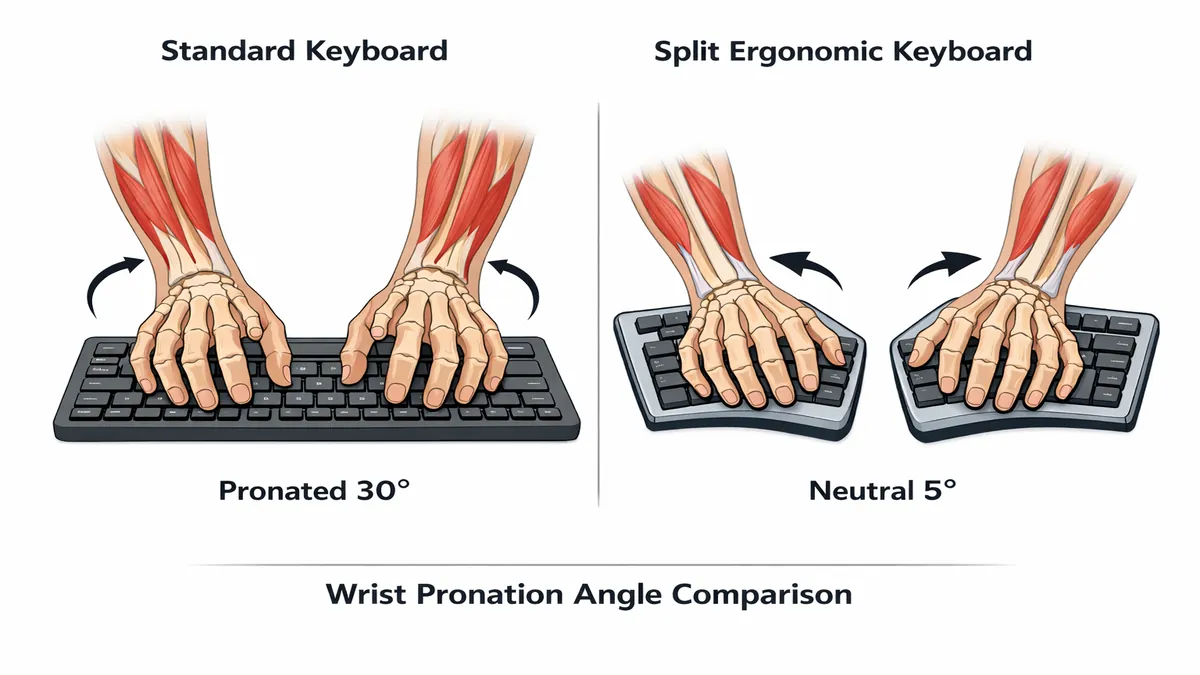
The shift to remote work and extended screen time has amplified the need for ergonomic solutions. Investing in an ergonomic keyboard is no longer a luxury but a necessity for anyone spending significant time typing. Here's why:
- Preventative Health: Ergonomic designs minimize awkward wrist angles (ulnar deviation and extension), reducing pressure on nerves and tendons, thereby preventing long-term injuries.
- Enhanced Comfort: By allowing hands and arms to rest in a more natural position, ergonomic keyboards significantly reduce muscle fatigue and discomfort, even during marathon typing sessions.
- Increased Productivity: A comfortable typist is a productive typist. Reduced pain and fatigue mean fewer breaks and sustained focus, leading to higher output.
- Customization and Adaptability: Modern ergonomic keyboards offer unparalleled adjustability, allowing users to fine-tune angles, tenting, and key layouts to perfectly match their unique body mechanics.
Quick Picks: Top 3 Ergonomic Keyboards
| Product | Best For | Score | Price Range |
|---|---|---|---|
| Logitech Ergo K860 | Seamless Transition & Comfort | 9.8/10 | Mid-Range |
| Kinesis Advantage360 | Ultimate Ergonomic Customization | 9.6/10 | Premium |
| Microsoft Sculpt Ergonomic | Affordable & Effective | 9.3/10 | Budget |
Detailed Reviews: The 5 Best Ergonomic Keyboards of 2026
1. Logitech Ergo K860: The Best Entry into Ergonomics
The Logitech Ergo K860 stands out as the most accessible and user-friendly ergonomic keyboard for those transitioning from traditional layouts. Its gently curved, split-keyframe design and integrated wrist rest provide immediate comfort without a steep learning curve.
Design and Comfort
The K860 features a distinctive curved and split layout that naturally separates your hands, aligning your wrists and forearms in a more natural posture. The integrated, pillowed wrist rest, made of three layers—memory foam, high-density foam, and a coated fabric—offers plush support, reducing wrist extension. It also includes adjustable palm lift, allowing you to tilt the keyboard at 0, -4, or -7 degrees for optimal wrist angle.
Productivity Features
Logitech's hallmark multi-device connectivity allows seamless switching between up to three devices via Bluetooth or the included USB receiver. The Perfect Stroke keys, with their spherical dishing, provide a satisfying, quiet, and precise typing experience. The Logi Options+ software enables extensive customization of function keys and includes
"Smart Actions" for macro creation.
Pros:
- Excellent ergonomic design for natural hand and wrist posture.
- Integrated, plush wrist rest for superior comfort.
- Seamless multi-device connectivity and powerful software.
- Quiet, satisfying typing experience.
Cons:
- Not hot-swappable or highly customizable in terms of switches.
- The curved layout might take a short adjustment period for some.
Verdict: For anyone looking to improve their typing posture and comfort without a drastic change from a traditional keyboard, the Logitech Ergo K860 is the best starting point and a fantastic long-term solution.
2. Kinesis Advantage360: The Pinnacle of Ergonomic Design
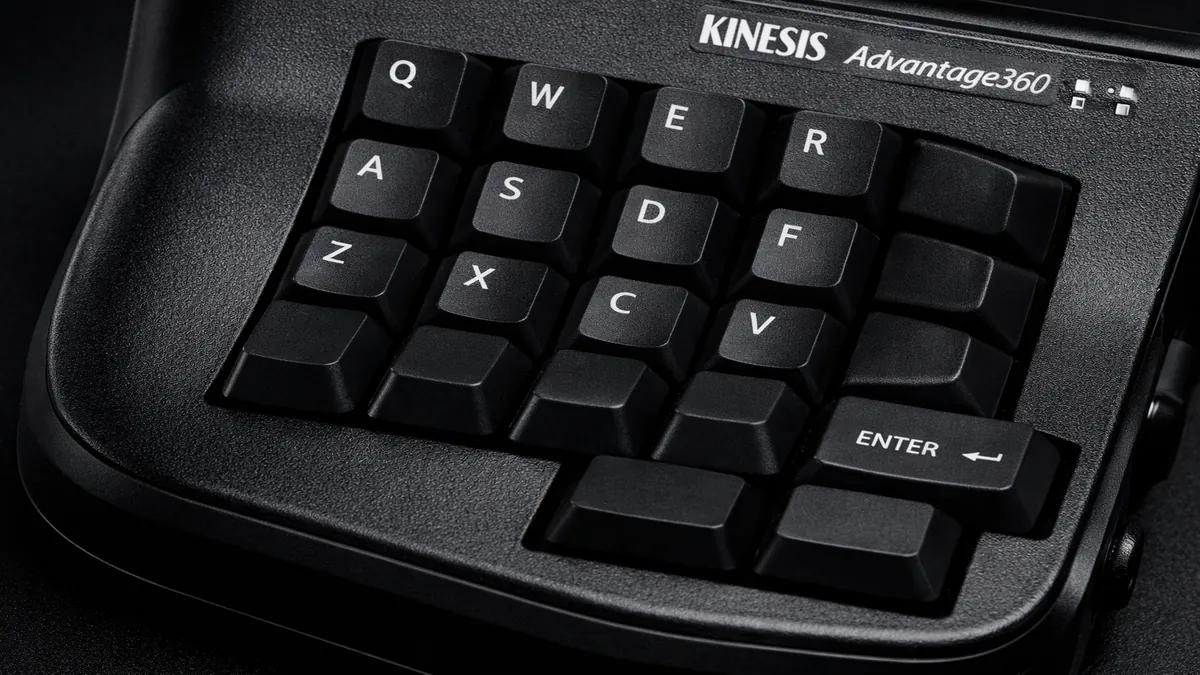
The Kinesis Advantage360 is not just a keyboard; it's a commitment to ergonomic health. Building on decades of research, this fully split, contoured keyboard is designed for the most demanding users who prioritize health and productivity above all else.
Radical Design for Optimal Health
The Advantage360 features two completely separate key modules, allowing you to position them at shoulder-width apart, eliminating ulnar deviation. The keys are arranged in concave keywells, which reduce finger travel and strain. It also offers adjustable tenting (up to 20 degrees) and negative tilt, allowing for a truly customized fit that aligns with your natural arm and wrist angles.
Programmability and Customization
Powered by ZMK firmware, the Advantage360 offers unparalleled programmability. Every key can be remapped, and multiple layers can be created for macros, shortcuts, and custom layouts. It comes with Gateron Brown switches, known for their tactile feedback, but the hot-swappable sockets allow for easy switch changes.
Pros:
- Revolutionary split and contoured design for maximum ergonomic benefit.
- Extensive adjustability for tenting and tilt.
- Fully programmable with ZMK firmware.
- High-quality mechanical switches and hot-swappable.
Cons:
- Very steep learning curve; requires significant adjustment time.
- High price point.
- Not ideal for casual users or those who type infrequently.
Verdict: If you are serious about ergonomic health and are willing to invest time in adapting to a new typing paradigm, the Kinesis Advantage360 offers the most advanced and customizable ergonomic solution available.
3. Microsoft Sculpt Ergonomic Desktop: Affordable Ergonomics for the Masses
The Microsoft Sculpt Ergonomic Desktop set (keyboard, mouse, and number pad) offers a surprisingly effective ergonomic solution at a very accessible price point. The keyboard itself is a standout, providing a comfortable typing experience that significantly improves on standard flat boards.
Design and Comfort
The Sculpt keyboard features a distinctive domed shape, a split spacebar, and a reverse-tilt design that encourages a more natural wrist posture. The integrated, cushioned palm rest provides soft support, further reducing strain. The keycaps are low-profile, offering a quiet and comfortable typing experience similar to a laptop keyboard, but with better key travel.
Wireless and Simplicity
This keyboard is designed for simplicity. It connects wirelessly via a 2.4GHz USB dongle, offering reliable performance without the need for complex software. While it lacks the deep customization of enthusiast boards, its out-of-the-box comfort and effectiveness are undeniable.
Pros:
- Very affordable entry into ergonomic keyboards.
- Comfortable domed shape and integrated palm rest.
- Quiet, low-profile keys.
- Reliable wireless connectivity.
Cons:
- Not a mechanical keyboard (uses membrane switches).
- No customization options for key remapping or macros.
- Requires a USB dongle (no Bluetooth).
Verdict: For budget-conscious users or those who want an effective ergonomic solution without a steep learning curve or complex features, the Microsoft Sculpt Ergonomic keyboard is an excellent choice.
4. MoErgo Glove80: The Open-Source Ergonomic Marvel
The MoErgo Glove80 is a relatively new entrant that has quickly gained a cult following among ergonomic enthusiasts. It's an open-source, fully split, contoured, and columnar keyboard that pushes the boundaries of what's possible in ergonomic design.
Columnar Layout and Thumb Clusters
Unlike traditional staggered layouts, the Glove80 features a columnar arrangement, where keys are aligned vertically, matching the natural movement of your fingers. Its most innovative feature is the extensive thumb cluster, which places frequently used keys (like Space, Enter, Backspace) under the thumbs, significantly reducing strain on the pinky fingers and improving typing efficiency.
Lightweight and Portable
Despite its advanced features, the Glove80 is incredibly lightweight, making it one of the most portable fully ergonomic keyboards. It connects via Bluetooth and is powered by ZMK firmware, offering complete programmability and multi-device support.
Pros:
- Advanced columnar and contoured design for superior ergonomics.
- Extensive and well-designed thumb clusters.
- Lightweight and portable.
- Fully programmable with open-source ZMK firmware.
Cons:
- Requires a significant adjustment period.
- High price point.
- Aesthetics might not appeal to everyone.
Verdict: The MoErgo Glove80 is for the adventurous typist who wants to explore the cutting edge of ergonomic design. Its open-source nature and innovative layout make it a powerful tool for those seeking ultimate comfort and efficiency.
5. Dygma Defy: The Modular Ergonomic Powerhouse
The Dygma Defy takes the concept of a split ergonomic keyboard and adds a layer of modularity and high-performance features, making it a favorite among gamers and power users who also care about ergonomics.
**Modular Design and
Thumb Clusters
The Defy is a fully split mechanical keyboard with hot-swappable switches, but its standout feature is the modular thumb clusters. These clusters can be configured with different key arrangements, allowing users to find the perfect setup for their thumb usage. This, combined with the ability to tent the keyboard up to 60 degrees, provides an incredible range of customization.
Gaming Performance and Aesthetics
Unlike many ergonomic keyboards that focus solely on comfort, the Defy is built for performance. It features a 1000Hz polling rate, N-key rollover, and vibrant per-key RGB lighting. The Dygma Bazecor software is powerful and intuitive, allowing for easy key remapping, macro creation, and lighting effects across multiple layers.
Pros:
- Fully split and highly modular design.
- Excellent thumb clusters and tenting options.
- High-performance features suitable for gaming.
- Powerful and user-friendly software.
Cons:
- Premium price point.
- The learning curve for utilizing all features can be steep.
Verdict: The Dygma Defy is the ultimate ergonomic keyboard for gamers and power users. It successfully merges high-performance gaming features with top-tier ergonomic design, proving that you don't have to sacrifice one for the other.
How We Test Ergonomic Keyboards
Testing ergonomic keyboards is a long-term process that goes beyond simple typing tests. Our evaluation focuses on the health and comfort benefits over extended use.
1. Long-Term Use and Adaptation
Our testers use each keyboard as their primary daily driver for at least two weeks. We document the learning curve, initial discomfort (if any), and the point at which the new layout becomes natural. We track self-reported levels of pain, fatigue, and comfort.
2. Posture and Angle Analysis
We use video and photographic analysis to observe how each keyboard affects the user's wrist, forearm, and shoulder posture. We look for signs of ulnar deviation, wrist extension, and shoulder hunching.
3. Adjustability and Customization
We test the full range of adjustments for each keyboard, including split distance, tenting angle, and tilt. We also dive deep into the software to evaluate the ease and power of key remapping and macro creation.
4. Build Quality and Typing Feel
Even with a focus on ergonomics, the core typing experience matters. We assess the quality of the switches, the stability of the keycaps, and the overall build quality of the device.
Ergonomic Keyboard Buying Guide: What to Look For in 2026
Choosing an ergonomic keyboard is a personal journey. Here are the key factors to guide your decision:
Type of Ergonomic Design
- Fixed Split (e.g., Logitech Ergo K860): The easiest to adapt to. Offers a good balance of comfort and familiarity.
- Fully Split (e.g., Kinesis Advantage360, Dygma Defy): Offers the most significant ergonomic benefits by allowing shoulder-width separation of the hands.
- Contoured/Columnar (e.g., Glove80): The most advanced designs that match the natural curvature and movement of your fingers. Requires the longest adaptation period.
Adjustability
- Tenting: The angle at which the keyboard is raised in the middle. This helps to keep your forearms in a neutral "handshake" position.
- Tilt: The front-to-back angle. A negative tilt (where the front is higher than the back) is often recommended to keep wrists straight.
- Split Distance: For fully split keyboards, ensure you can position the two halves comfortably at shoulder width.
Learning Curve
Be realistic about the time you are willing to invest. A keyboard like the Logitech Ergo K860 might take a day to get used to, while a fully columnar board like the Kinesis Advantage360 could take several weeks to master.
Frequently Asked Questions (FAQ)
Q: Will an ergonomic keyboard cure my wrist pain?
A: While an ergonomic keyboard can significantly alleviate and prevent pain by promoting better posture, it is not a medical device. If you have persistent pain, you should consult a healthcare professional. An ergonomic keyboard is a tool for prevention and management, not a cure.
Q: Are ergonomic keyboards good for gaming?
A: It depends on the keyboard and the user. Some gamers find split keyboards like the Dygma Defy to be superior, as they can place a joystick or other peripherals between the two halves. However, the non-standard layouts can be challenging for games that use a wide range of keys.
Q: Why are ergonomic keyboards so expensive?
A: The cost is due to the complex designs, smaller production runs, and extensive research and development that go into creating them. The use of high-quality mechanical switches and advanced features like hot-swappability and programmability also adds to the price.
Q: How long does it take to get used to an ergonomic keyboard?
A: For a simple split keyboard, it can take a few hours to a few days. For a more radical design like a columnar or contoured board, expect a learning curve of one to four weeks before you regain your full typing speed.
Final Thoughts
Investing in an ergonomic keyboard is an investment in your long-term health and well-being. The market in 2026 offers a solution for every need and budget, from the gentle introduction of the Logitech Ergo K860 to the uncompromising, deep ergonomics of the Kinesis Advantage360. While the initial adjustment period can be a challenge, the long-term benefits of reduced pain, increased comfort, and sustained productivity are well worth the effort. Your hands and wrists are your most valuable tools in the digital age; choosing a keyboard that supports them is one of the smartest decisions you can make.
Affiliate Disclosure: ATechGuides is supported by its audience. When you purchase through links on our site, we may earn an affiliate commission. All products are independently selected and tested by our editors.